Once upon a time, a girl lived on the edge of Williamsburg and Greenpoint, just Under the Brooklyn-Queens Expressway, in the mythical kingdom of North Brooklyn. She walked around and talked to people, took pictures and thought about things. She wrote things down and was happy.
It's autumn, and what better time to 1) cook local vegetables in new and delicious ways, and 2) laugh at cute vegetables being murdered while ruminating on past relationships. If these activities appeal, then fellow Brooklyn residents Ameet and DV have the sites for you (and for Ameet I'll even bury the hatchet):
In the lee of the mortuary, weathered Victorian brick itself in the lee of the Court, there’s a victims’ shelter, an art gallery, and a costume shop, and you can steal looks into the long windows as you walk up Saltmarket, continue on High, and arrive at the dappled, climbing Necropolis, beneath which is a brewery and a museum that delights in our believing.
"I went wandering whither chance might lead, in a still ecstasy of freedom and enjoyment; and I got...into the heart of city life. I saw and felt London at last: I got into the Strand; I went up Cornhill; I mixed with the life passing along; I dared the perils of crossings. To do this, and to do it utterly alone, gave me, perhaps an irrational, but a real pleasure... In the city you are deeply excited."Villette, Charlote Brontë
I have wandered wherever luck takes me ("Be well. Be lucky," Leonard Cohen said last night). I have gained an ecstasy of peace without realizing it. I found an old friend in Dublin, I find a new one in Glasgow ("dear green place"), which is more hardscrabble and hence more, in a way, me (but less home than Dublin, which has held my heart for years).
I have seen and felt Glasgow. I passed the old Custom House; I went up Saltmarket to the Necropolis; I listened to the round-cornered talk all around me; I bought green beans and apples and chocolate. The key is indeed the solitude...and the pleasure is not irrational.
Happiness with the Dubs, happiness with the Weegies. (And think how great Brontë would be considered today if she had better bandied words like "weegie.")
Since I've had poetry on the brain, it was nice to turn to the old familiar Times (homesickness is the gift of fresh eyes) and find an op-ed section devoted to the words and voices of five poets. A is for Ashbery, B is for Bang...and theirs were the poems I liked best.
I am on the edge of my seat here...on the edge of my bed, rather...because it's bedtime in Dublin, and I am dreaming of waking to good news.
The 2.5-inch headline in a Dublin daily yesterday: "Barack to the Future in U.S?" Then: "It's decision time. The most dramatic election ever seen in Ireland is about to reach its climax - and the Irish don't even have a say in it."
I'm off to Ireland and Scotland and, as always, felt that pre-homesick pang yesterday, walking around this dear neighborhood. Since the Pool is now under construction (they're building a Skate Park on the south end, and refurbishing the arch - both projects slated for completion in 2009), I tried to capture a little of what the space is now...inside and out.
Here's to coming home to President-Elect Obama and a joyful November.
I forgot, yesterday, to mention four lines Ashbery read from four different poems, on Monday, which themselves could make a poem (poet: Ashbery, editor: Me):
"He wears a question in his left eye. The land was made of paper. The print could rhyme with a falling star. Things merely ended when they ended."
And, still considering the tongue, we went to the Taste of Greenmarket benefit on Wednesday (all proceeds benefitting the Greenmarket/Council on the Environment of NYC, and I decided to eat meat. It's a foray I haven't made since February 2006, when I ended a year of chef apprenticing and meat exploration with a steak in Buenos Aires. That year reminded me of the reasonsI'dbecomevegetarian when I was 19, and I went back to it feeling very alive and very grateful. I found that, having been vegetarian for so long, eating meat became a spiritual experience during which I could visualize another animal's body becoming part of my own. I decided on Wednesday to feel this deep connection again, by tasting as many animals as possible (five!), all raised humanely on local turf, as follows:
Chicken by Michael Anthony of Gramercy Tavern (courtesy my Swedish chef friend Svante, who after all did not move to Italy): skewers of Norwich Meadows Farm Chicken, Husk Cherries [aka tomatillos!], and Cherry Lane Farm Brussels Sprouts.
Pork and Duck by Mary Cleaver of The Green Table: Greenmarket Gumbo with Flying Pigs Pork and Quattro's Game Farm Duck.
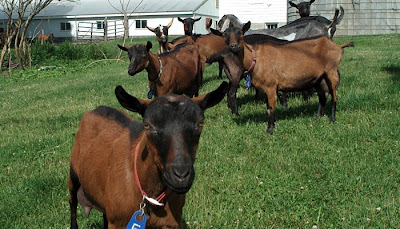
Goat by Patti Jackson of Centovini, I Trulli: Farroto with Lynnhaven Braised Baby Goat and Autumn Vegetables from Mountain Sweet Berry Farm, Paffenroth Gardens, and Gorzynski Ornery Farm.
Oysters by Marc Meyer of Cookshop: Fried Blue Moon Oysters, Red Jacket Orchards Apple Slaw, and Eckerton Hill Farms Chili Remoulade.
Pork by Damon Wise of Craft: Braised Pork Cheek, Pickled Black Trumpets, Butternut Squash and Pancetta Vinaigrette, featuring produce from Paffenroth Gardens.
All told, more than 11 local farms provided the vegetables and animals for these dishes. Kind of like lots of Ashbery lines combining into something nourishing and new.
"I think you (and John, too, for that matter) must watch what is always the great danger with any 'surrealistic' style, namely of confusing authentic nonlogical relations which arouse wonder with accidental ones which arouse mere surprise and in the end fatigue." - W.H. Auden, in his 1956 rejection of Frank O'Hara for the Yale Younger Poets Prize. I heard Ashbery (who was 29 in 1956) read on Monday, at the Y, his breath hardly caught between poems, and bearing easy. He actually didn't read one of his poems that, for whatever reason of timing and light, struck me the most, back in May 2004, when it appeared in The New Yorker:
Wastrel by John Ashbery
Dear spit, the week is turning over with the world. All is angry shouting outdoors. I feel like one of St. Ursula's virgins taking a last look at shelving rock and tree, sailing into what must be the ineffable if indeed it means anything to itself.
Tomorrow the stone judge will be here, then more and more pioneers, covering the basin as far as one can see into blue beginnings. The have their place in the populations, but are nominally no more than we, planted here to survey them and moving backward with sips of the tide.
We knew the tower bridge was jury-rigged, the spirit spoof a trickle in the eye of God we behold from a questioning though necessary distance. In summer it was straw hats and licorice, which, fading, leave a taste for other novelties and sundries. It is never too late for stealth, mourning itself, or the other irregular phantoms.
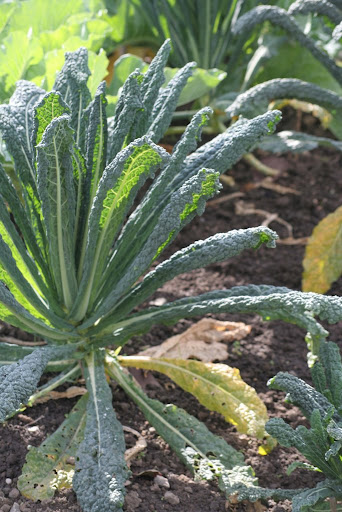
Ingredients: *a handful of couscous *some garlic and shallots, minced *half a dozen leaves Italian kale *a daikon radish *some chopped onion *some olive oil *some lemon juice *a handful of dried berries *lettuce leaves *feta *a dressing of mustard, balsamic vinegar, olive oil, thyme, and soy sauce *salt, pepper, and a few hot pepper flakes
Instructions: Sauté the onion, radish, and kale (in that order) in hot olive oil. Add some lemon juice. Boil water and cook the couscous with the garlic and shallots; add berries. Tear up some lettuce, sprinkle with feta, and dress lightly. Season the hot couscous and sautéed vegetables, mix into the crisp salad, and eat immediately, preferably while reading a magazine, wrapped in a blanket.
"The voidness of the universe is capable of containing all things of various forms and shapes, such as the sun, moon, stars, mountains, rivers, the great earth, springs, streams, mountain torrents, plants, trees and woods, good and bad people, good and bad things, heavens and hells, all the great oceans. All these are in the void. The voidness of worldly people is also contained in it. " -Altar Sutra
There's something about a coil. The black licorice phone cord. And the chignon against a word like nape. The snake, resting dryly, tasting the light. The thin curl of smoke from a thin cigarette. A spiral of Cumberland pig. And springs and boing, hives and buzz. And screws for twisting corks of sky, and a spiral nebula, which is a spiral galaxy, and the more amorphous patterning, round and round figure-eighting, which spirographically sighs nothing new and once upon a time.
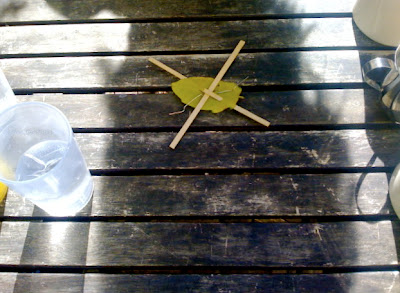
When the landlords wanted to raise rents from $2,400/month to $6,000+, Laurence Elliott, proprietor (with wife Ayako) of the old Read Café, headed south. His new joint, Rabbithole (Bedford and South 3rd, marked by a carrot), serves ~$12 brunch plates, including things like soft French omelettes with goat cheese and tomatoes, fennel and raisin french toast, baked eggs with Mornay sauce, and spicy corn salad. The coffee is good and the outdoor garden lively and peaceful at once - prepare to enjoy it because the wait for food can be long (a waitress today was overheard saying that the cooks are still learning the recently changed menu). On this fine morning/afternoon, T and I occupied ourselves by recounting urban escapades and making leaf sculptures (photo courtesy T, shadow courtesy me).
The monthly rag, Williamsburg Greenpoint News+Arts, recently featured an article about Rabbithole by Carlos Centeno, who writes, "Rabbithole, which opened in June, has brought much of the Read's zest and spirit to the Southside...It retains the same neighborhood hangout vibe, with regulars coming in as often as three times a day." The indoor space is indeed spacious and cozy, with lots of wood, the smell of things baking below-ground, and friendly people sitting with mugs and books.
Neither among customers nor cooks is there the slightest trace of a hurrying hare.
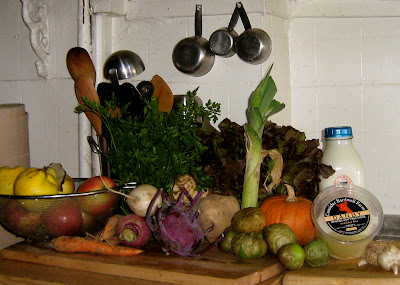
From left to right: Red Jacket Orchardsquince and Pippin and Fuji apples; Hearty Roots Farm carrots, turnips, parsley, kohlrabi*, celeriac, potato, lettuce, leek, and baby bear pumkin; Red Jacket Orchards tomatillos;Consider Bardwell Farm Danby Feta**; Ronnybrook Farm milk (my new favorite thing: the organic, straight-from-the-cow and minimally processed milk costs $2.25/quart when you return the previous week's glass bottle. The farm also offers yogurts, crème fraîche, half-and-half, butter, and eggs); and local garlic (the woman from whom I purchased the bulbs called them "wee").
Not pictured: bok choy and, from last week, green cabbage, daikon, eggplants, beets, kale, collards, broccoli, thyme...
*From Hearty Roots weekly update: "Kohlrabi is a German word meaning turnip cabbage. The preparation can be as easy as radish and delicious eaten raw. Peel the outer skin with a paring knife. Slice, dice, or grate, and add to salads. Use on raw vegetable platters or serve with a creamy dip. Substitute in recipes calling for radishes. Grated kohlrabi can be added to slaw, but lightly salt it first and let stand for several minutes. Squeeze to remove any excess water before adding dressing. Kohlrabi can also be steamed or boiled. For this preparation don't peel until after they are cooked. Steam or boil until bulbs are tender, peel skin, and season with butter, salt, and pepper, a cheese sauce, or just enjoy plain."
**"From Consider Bardwell Farm's cheese descriptions: A firm yet crumbly, sharply tangy and salty raw-milk cheese in the Greek Feta style, made from goat’s milk and aged in brined whey. We often drizzle this cheese with a little light oil and herbs but it is also a great addition to fresh green salads and pizza. It is available by the round or wedge, or crumbled and marinated in 8-ounce containers."
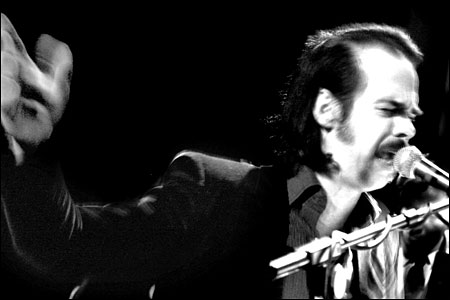
Free association makes constellations of disparate stars - and some of the forms burn brighter, whether because of fate or timing or dumb luck. I saw Woyzeck, with music by Nick Cave, at BAM tonight. Chris Isherwood didn't love it, claiming that it lacks the tragic spirit of Georg Büchner's still-modern 1836 play (unfinished and fragmentary when the author died at 23). Yet...this increasingly disjointed, stimulus-driven world can be well served in art, I think, by expanses of silence - and also by rapid-fire sensory experience and juxtapositions of the sweet and the horrible, of which this version of Woyzeck delivers plenty. I found it evocative and sad, and drew star patterns with the themes of torture, simplicity versus mechanization, true love versus material splash, inwardness, modern despair, and the loss of innocence and thoughtfulness in a world of brutality and homogenization.
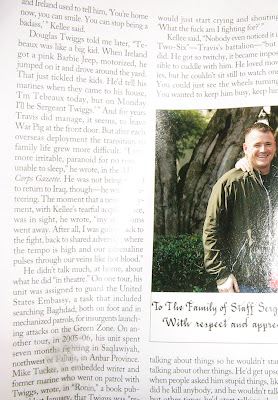
Woyzeck slowly goes mad, experimented on by doctors in order to earn money for the woman he loves, crazed by this woman's affair with the drum major, and dehumanized in his milirary experiences. Today, I was reading an article from the September 29th New Yorker, about the great love some people bear the U.S. military, even while their experiences in it unravel their lives. Travis Twiggs, a Marine deployed to Iraq and Afghanistan five times, is the article's tragic protagonist. Following his various stints in the Middle East, and the torment of coming home, Twiggs (courageously) shared with the military community his experience with Post-Traumatic Stress Disorder (PTSD), and worked with returning soldiers who suffered from it. For myriad reasons, and despite being well loved, Twiggs committed suicide in May.
In January, Twiggs had written, "Every day is a better day now. As my body and mind grow stronger...so does my spirit. I see everything so much differently now. Looking back, I don't believe anyone is to blame for my craziness, but I do think we can do better. We have got to make our Marines and sailors more aware of PTSD before they end up like me and others."
According to the New Yorker article, a RAND Corporation study estimated that nearly 20 percent of people who have served in "America's post-9/11 wars" suffer from PTSD, which many doctors believe should be considered not a disorder but an injury. That's 300,000 veterans. Yet Dr. Ira Katz, chief of mental services at the Department of Veteran Affairs, in hearing about numbers like these, wrote in an e-mail to a colleague, "Shh!...Is this something we should (carefully address ourselves in some sort of release before somebody stumbles on it?"
This is the world Woyzeck lives in. It's also a world of love, potentially. The New Yorker article is as much about Twiggs' wife, Kellee, as it is about him. If cowardice is many costumes...courage is many different kinds of nakedness. Kellee remembers, "He'd hear a car coming up our gravel road here and just hit the floor, just bam, because the tires crunching sounded like machine-gun fire to him. Or he'd just go sit upstairs and watch for lights - watch for Iraquis, because that's what he used to do in Iraq. I'd call his name, get him back to bed, and the only way I could get him to sleep was to put him in a bear hug and rock him. Then he'd sleep."
This is the world Woyzeck lives in. Tom Waits wrote a musical based on the play in 2002, called Blood Money. It incorporates Waits' signature carnival sounds with poignant lyrics and vocals that, by turn, grate and break the heart.
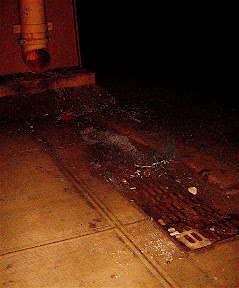
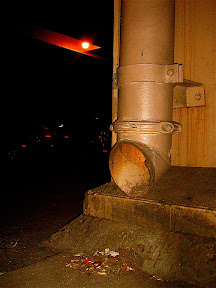
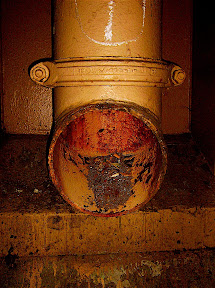
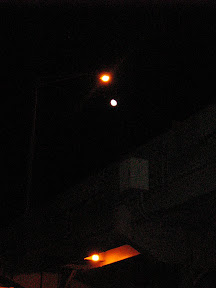
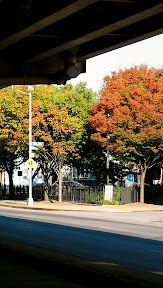
I went walking when I got back to this corner of Brooklyn tonight, and captured, Under the BQE, my own version of these stars, this moon (the middle light in the last photo), and the surrounding dark.
We wanted real issues during tonight's third and final presidential debate, and what did we get? From Barack "Eight-Year-Old Terrorist Prodigy" Obama: more intelligent, graceful proof that there will be a steady hand at the wheel come January 20th. From John "Hatchet to the Head" McCain: more self-satisfied and inarticulate hogwash - and you can't even put lipstick on hogwash.
But despite their differences, both candidates steered clear of a big issue on the minds of many Americans tonight (yes, perhaps even Joe the Plumber). That issue? Penguins. America, allow me to set the record straight:
(The release happened 10/4/08. Sure, energy was required to make it happen. Sure, the future of the little guys is uncertain. But a bunch of people banded together to do something with a heart - and that's a beginning, whether on La Calle Main or Pennsylvania Avenue.)
The site came to my attention whilst reading a recent Rolling Stone article about the new, "naturalist" face of humor: "The new deadpan style has reached its purest expression in Dan Walsh's Garfield Minus Garfield. Last February, Walsh started posting Jim Davis'Garfield comic strip online, with one significant change: he deleted Garfield. In cutting the cat, Walsh put the strip's straight-man protagonist, Jon Arbuckle, in a Beckett-like world of semicomic despair. Davis, embracing the zeitgeist, gave the remix his blessing."
Says Walsh of his own (re)creation, "[It's] a comic about schizophrenia, bipolar disorder, and the empty desperation of modern life...a journey deep into the tortured mind of an isolated young everyman as he fights a losing battle against loneliness and methamphetamine addiction in a quiet American suburb."
The poor guy who was hit by a car on Kent Avenue last month spoke at the NAG town hall meeting last week. Hopefully, like the Bible gang, preservation begets preservation, and salvaged/created bike lanes will in turn generate more green spaces and (is it too much to hope?) preserved factories.
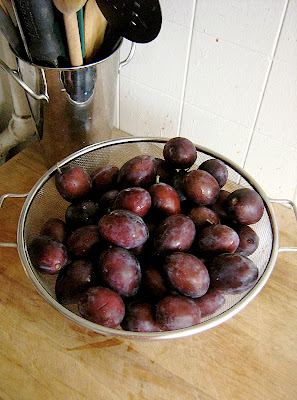
A couple of weeks ago, I realized, for the first time since seven years ago, when I lived in Marble Hill (dear little bit of the Bronx that, despite the Harlem River, sometimes fancies itself Manhattan), that I could, when the satellites are properly aligned, or the can held to the fence just so (as described in an April New Yorker article about field recording in Appalachia (which sometimes fancies itself Ireland)), tap, here in North Brooklyn, WFUV, the station that fell into my poor bright apartment on Adrian Avenue (from the fire escape of which the George Washington Bridge was strung like a necklace over the Hudson at night), and listen to things like Ceol na nGael while canning plums and daydreaming about the mountains along I-81.
Between Roanoake and Bristol, pointed toward Montgomery:
And there's something very hopeful about radio. M. Ward, who channels things like chandeliers and graves and ranch hands and tides (and perhaps fancies himself from southeastern Virginia, though he calls Oregon home) devotes an album, Transistor Radio, to lost voices in perpetual broadcast.
"Just once I knew what life was for. In Boston, quite suddenly, I understood..." Anne Sexton
The BQE is really a dragon. It's a place under which sounds grow like mouths into more important selves. It's aloneness swallowing itself. The BQE is the horn of a ram and its perpetual bellow. It's where rain doesn't fall. The BQE is brainchild of a mad planner, and a travesty. It's the only kind of tragedy, a long siren from Queens to Brooklyn. And sometimes it just wants to be a number, and sometimes the sum of green signs. The BQE is a-hum. It laughs at your impatience the way a mountain laughs without laughing, just a rumble somewhere far inside and long ago. "Just once I knew what life was for," she says. But it was not in Boston, it was beneath this concrete spine.
Ports of air – transient ports of despair, and, worse, minor and constant annoyance – also house infinite hope, the possibility of anywhere, or nearly. I will never have the smooth tan back of the woman in the mustard halter, kneeling on a chair like an airport pet. Let her stand in for everyone and everything I will never be. Everyone in a hurry, everyone waiting. The hustled kids, perfect jet-setters, roller bags, beeping carts, silvery pilots, pills, souvenirs, loungewear and desert fatigues, comfortable heels and sunburns, coffee, candy, denial beers, crosswords, and watches. Let it all take off into a bruise-colored Atlanta sky, leaving behind this monument to elsewhere. Stripped of breathing and rush, the destinations would disappear, and the arriving.
I could excerpt dozens of passages from last night's debate (now in 10 easy minutes), but let's get to some of the energy/environment talk that must, in my mind, underpin absoluteley every other decision we're making as individuals and as a country.
Ifill: "Let's talk about climate change. What is true and what is false about what we have heard, read, discussed, debated about the causes of climate change?"
Palin: "Well, as the nation's only Arctic state and being the governor of that state, Alaska feels and sees impacts of climate change more so than any other state. And we know that it's real. I'm not one to attribute every man - activity of man to the changes in the climate. There is something to be said also for man's activities, but also for the cyclical temperature changes on our planet. But there are real changes going on in our climate. And I don't want to argue about the causes. What I want to argue about is, how are we going to get there to positively affect the impacts? We have got to clean up this planet. We have got to encourage other nations also to come along with us with the impacts of climate change..."
[RB: or howsabout going along with other nations on this one and signing Kyoto. For crying out loud.]
Biden: "Well, I think it is manmade. I think it's clearly manmade. And, look, this probably explains the biggest fundamental difference between John McCain and Barack Obama and Sarah Palin and Joe Biden - Governor Palin and Joe Biden. If you don't understand what the cause is, it's virtually impossible to come up with a solution. We know what the cause is. The cause is manmade. That's the cause. That's why the polar icecap is melting. Now, let's look at the facts. We have three percent of the world's oil reserves. We consume 25 percent of the oil in the world. John McCain has voted 20 times in the last decade-and-a-half against funding alternative energy sources, clean energy sources, wind, solar, biofuels. The way in which we can stop the greenhouse gases from emitting. We believe - Barack Obama believes by investing in clean coal and safe nuclear, we can not only create jobs in wind and solar here in the United States, we can export it."
Okay. So Sarah Palin, in the words of my grandfather, is "not too bright." But I hate to say it: clean coal is also not too bright...or, more accurately, it doesn't frigging exist. But everyone has to play the game, and Biden is just doing his part. The test is going to be what happens when all the rhetoric falls away.
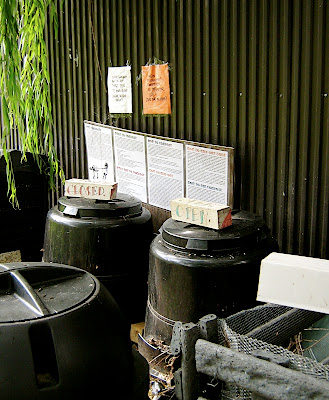
Earlier this week, I heard Colin Beavan, aka No Impact Man speak at the North Brooklyn Compost Party. He has his critics, too, and he doesn't to my mind address one of the core problems, which is how to make local, sustainable foods and products available to lower-income people, but at least he is walking the walk...often literally...with trustee mason jar coffee mug. He said something cool, too, at Urban Rustic. He said, when asked what other people can do to make a difference, that the best thing anyone can do is to hold onto that question all the time.
Okay, so how can I make a difference? Two choices I made this past week hopefully acted out a positive response to that question (and perhaps cancelled out my paper coffee cups and new winter coat (!))...
First, I switched to ConEdison Solutions electricity, so that all of my electric needs are now supplied by wind power. Says ConEd: "Wind power is now the fastest-growing renewable energy source in the world and is 100 percent pollution-free. The wind power used is supplied [by] Community Energy, Inc., and comes from modern wind turbines mounted on tall towers on farmland in upstate New York and Pennsylvania."
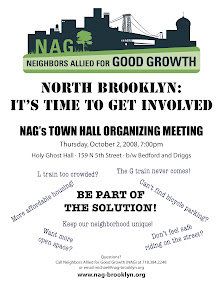
And second, I went to the Neighbors Allied for Good Growth town hall meeting last night (before the debate), where, in a break-out session, I shared my three main concerns with a small group of other Williamsburg and Greenpoint residents; these include a) promoting dialogue between long-time residents and newcomers and preserving old buildings, 2) reducing litter, and 3) preserving and creating new open/green spaces throughout the neighborhood (guerrila gardening anyone?). All told there were 100+ people at the meeting, probably 70 percent over 35, 90 percent white, and 75 percent residents of the neighborhood for more than 10 years (I was part of a 3-4 percent minority who had been here for under two years). It was as cool and empowering as, later, taking a drink every time a candidate said "folks" or Biden chuckled at the nonsense uttered by his opponent.
So, in conclusion, Withers Street is Main Street, too! And I think, given good information, even Joe Six-Pack might be counted on to make some good political and lifestyle choices. And, certainly, to eat at Bamonte's.
Come celebrate turning food to earth and back to food at a compost party, tonight, at Urban Rustic, from 6:30 until whenever. A $10 entry buys good company, local snacks and drink, and a chance to voice ideas about how to improve North Brooklyn composting. A much better option than eating worms.
(*I actually do like Matt Damon; I've heard from reputable folk that he's a decent guy...but I also like making myself crack up on Monday nights, while watching, say, a silly romantic comedy (in which it is snowing!), eating a CSA salad, and feeling happy...as the economy goes down like a ship.)
Physics for a Sunday Morning in Brooklyn in September
If there’s no theory linking a lepton to the speed of light, how can we hope to link the Klenosky Paint sign to the falling acorns to the drunk king feeling bad and the sun hitting his face just so.
“We are such spendthrifts with our lives. The trick of living is to slip on and off the planet with the least fuss you can muster. I’m not running for sainthood. I just happen to think that in life we need to be a little like the farmer, who puts back into the soil what he takes out.” Paul Newman
A heads-up to all the locals: there will be a Happy Hour, which is to say, Town Hall Meeting, at the Holy Ghost Hall, on North 5th between Bedford and Driggs, on Thursday, October 2nd, at 7 p.m. It's sponsored by Neighbors Allied for Good Growth, and wouldn't it be great to go?
"And when the day of Pentecost was fully come, they were all with one accord in one place. And suddenly there came a sound from heaven as of a rushing mighty wind, and it filled all the house where they were sitting. And there appeared unto them cloven tongues like as of fire, and it sat upon each of them. And they were all filled with the Holy Ghost, and began to speak with other tongues, as the Spirit gave them utterance."
And, lo, they figured out how to make the L train less crowded, and how to rally for more affordable housing, and how to pick up trash and call for more trash cans, and how to advocate for more green spaces. And in their communion Williamsburg/Greenpoint remained a paradise unto itself, west of the ocean and east of the river, and even the bricks were glad.
Bronze plaques are disappearing all over Williamsburg/Greenpoint, some say for scrap. Included in the lost is the memorial I once passed several times each day, just Under the BQE, dedicated to Father Giorgio in 1951. For all plaque thiefs checking this blog: not cool.
Father Giorgio, incidentally, taught children in Williamsburg, was drafted as a chaplain into the Army during WWII, and, 36-years-old, died of blood poisoning related to his newly amuptated leg, upon returning to Brooklyn.
Among other things (closeness, renewed longing for the road, tired feet), Calexico tonight offered up a song which I'll post as aural plaque to Father Giorgio, defying the hoodlums again.
"Four in the morning the sidewalk's asleep Dogs on the porch Spiders on the leaf Shipwrecked by night sailing through days Nobody noticed the slipping away..."
Mystery solved: the new outdoor, impromptu café between Green Dome and the dog run is operated by Urban Rustic (making Whole Foods look like Key Food since 2007). The free-trade coffee is pretty good. And the weekend cook is not into Jo Micek's turf. Just this morning, the home composting advocate proffered a strip of rolled-up grass, as an of-the-moment mat, and was brusquely dismissed by the cook who, to be fair, was perhaps just trying to put the "urban" back in urban rustic.
Perhaps the unrecognized Dalai Lama of fashion, Marc Jacobs on MarcJacobs: "I started to develop a sense of, I don't know, a sense of confidence. All of a sudden, before I knew it, I started to think, Gee, I'm really happy with the work we've been doing. I'm really happy with the house I live in. I'm really happy with the way I look... I like taking a shower. I like shampooing my hair. I like putting on moisturizer. I like wearing jewelry. All of these things, I used to think, That's not for me. I'm on the floor picking up pins or I'm sketching all day, what does it matter what I look like? And then I discovered, you know what? It does matter. It makes me feel good. I get it!... I have a choice. We all have a choice in how to look at things. This idea that everything happens for a reason and is perfect and you will benefit from it even if you can't see the benefit - it's a nice ideal to subscribe to."
I like watching fashion shows. There's something about the rhythms and the living art of a lot of pieces, which trickles down in the most basic way to our own clothes, that's full of a strange kind of perpetual hope. (Seriously!)
This also seemed like a relevant post given that the latest Time Out provides us with at least a couple of ways to "shop" in Williamsburg, whether on the street with Tiffany or in the slew of other little spots that clinched the title of "Best Shopping" for the hood. I personally would have had a category for "Best Grittiness," or "Best Views of the Rising Harvest Moon" (which, risen, is a great accompaniment to pears and wine and laughter at little autumn bistros like Le Barricou).
"Does it break my heart, of course, every moment of every day, into more pieces than my heart was made of. I never thought of myself as quiet, much less silent, I never thought about things at all, everything changed, the distance that wedged itself between me and my happiness wasn't the world, it wasn't the bombs and burning buildings, it was me, my thinking, the cancer of never letting go, is ignorance bliss, I don't know, but it's so painful to think, and tell me, what did thinking ever do for me, to what great place did thinking ever bring me? I think and think and think, I've thought myself out of happiness one million times but never once into it." Jonathan Safran Foer, Extremely Loud and Incredibly Close
"And yet and still, while she lived, she was often such a wonder to me! All these things I knew: that she had painted the nose cones of bombs during the second World War; that she smoked cigarettes and bowled and had a Canadian lover before she met my father; that she gave birth to three children in three different cities in the span of six years; that she traveled across America with my father, seated on the back of a Harley-Davidson motorycle!; that she was once so angry at my father (in Jackson, Michigan, on Walker Street) that she threw her wedding band into the flames of the coal furnace that she stoked on winter mornings; that she loved books and songs by Chet Atkins and the Sons of the Pioneers; that she adored the New York Yankees when they were golden in the 1950s; that she walked through woods near three Great Lakes; that she outlived two sons and a husband - all these things I knew. I never knew her, though." my mom, a letter
They've torn down the south wall on the exterior of the Pool, and all the south-facing trees have little scaffolds around them. I wish I had taken some photographs of the wall beforehand, because it seemed enchanted, with the green all climbing up the brick and stray cats taking advantage of the shadows. Now you can see the condos on the other side.
I think too much, like my mom. I run obstinately and love garlic and try to keep things simple, like her mom. Every thought and love I have has its own genealogy, and it can be exhausting.
Where I've Gone
I am not clicking down the street toward a girl running toward me, clothes the color of planetree leaves still cleaving to branch. I am not shouldering a rake and grinning at a girl whose ears are filled with song, I am not tipping the hat of my smile to her day. You think I am, but I am not the girl. I am also not a flock of doves scared up from the ball field near the garden where Hasidim and Dominicans don caps and forget everything but well packed earth and the clarion of wood to hide.
In Woody Allen's latest, one of the characters is defined as one who goes through life knowing not what she wants but what she does not want. Increasingly, I know what I want - and it is what I have: the BQE, cats (feline and human), kind company for things like Woody Allen films and rain, local food, poetry, and, generally, this great, brief quest.
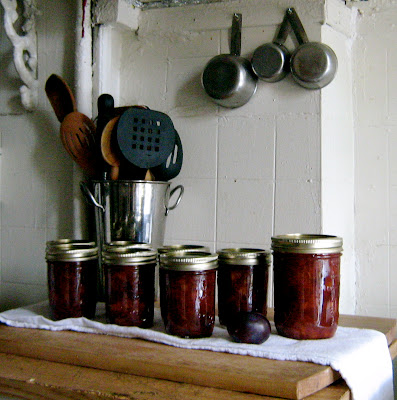
And what better way to quest on a surprisingly hot Sunday than to talk to my grandfather for an hour (more kind company), then go into a predictably steaming kitchen and stain and cut the fingers on plums, for the sake of winter jam?
Today's Plum Jam
Ingredients 4 lbs. Red Jacket Orchard empress plums 1/2 c. water 1/2 c. lemon juice 2 c. sugar 1 package Pomona's Universal Pectin (citrus pectin activated by calcium instead of sugar, meaning jams can be made more naturally - Pomona's is available at The Brooklyn Kitchen.) 8 tsp. calcium water (requisite powder included with the pectin)
Directions 1. Heat but do not boil 9 1/2-pint Ball mason canning jars, their lids, and rims (jars also available at The Brooklyn Kitchen, other local kitchen shops, or online); turn down heat and let jars, lids, and rims stand in hot water. 2. Prepare calcium water according to package instructions. 3. Prepare plums: wash and dry; cut in half and remove pits; and cut each half into six pieces. Leave the skins on the plums - they break down nicely and add good color to the jam. 4. Put chopped plums into large pot with the water. Put lid on pot and bring to contents to a boil. Reduce heat and simmer gently for ~10 minutes, until liquid has formed and plums are breaking down. 4. Meanwhile, put sugar into a bowl and add pectin powder. Combine well. 5. Add lemon juice to simmering plums, then stir in sugar/pectin mixture, combining well and bringing to a boil for 1-2 minutes. 6. Remote pot from heat, fill jars, wipe rims, seal, and process in hot water bath for five minutes. Remove jars and let cool. Jars are properly sealed if center of lids indent during cooling (popping sounds are music to the canner's ears!).
I've scoured a bunch of sites for canning information; Fresh Preserving (a site run by Jarden/Ball that belies the typical assumption that corporate sites are misleading) is really comprehensive, with a range of recipes for preserving (including non-canning methods like freezing and dehydrating), a thorough how-to section, and FAQs.
One of the best parts of all of this? It's earth to earth. The empress plums I used were grown just 300 miles away, in Geneva, New York (not too far from the Owego farmland of my forebears); I used the whole plums, minus pits, for jam that will last long beyond this summer; and the pits will go to compost, becoming soil for next year's gardens.
As this year's grows from everything that came before.
I think I've loved the BQE from the beginning because it's the underdog of expressways, as a couple of quotes illustrate:
"I-278 (specifically, the Brooklyn-Queens and Gowanus Expressways) has to be the worst excuse for an interstate highway in the whole country. It is a series of different roads thrown together. Many entrance ramps have no acceleration lane at all and have STOP signs where they join the expressway. On the Grand Central Parkway, which is part of I-278 at the parkway's extreme western end, there is a sign saying 'EXIT 4 (I-278 / Brooklyn-Queens Expressway).' To continue on I-278, one has to exit onto a single lane ramp. All this when I-278 should be the mainline and the Grand Central Parkway should be an exit of I-278... The frequency of these problems collectively put I-278 in the hall of shame." Ty Rogers, on Kurumi's Humble House of Roadsdom
"The worst limited-access highway I've ever seen was the Brooklyn-Queens Expressway. Upon entering it from the Bronx, I sneered at the posted 45 MPH speed limit. I soon found out why it was posted." Steve Riner, web author of Minnestota Highways, a visit to which set me craving the piney Highway 61 drive from Duluth to Grand Marais.
Maybe in the unrhymed re-release, revised lyrics can have the killin' done out on Interstate 278...
Serendipitously - is there any other way? yes, gods, I'm asking you... - I ran tonight by what looked like a shop but is really a gallery...but is also a shop, on Leonard and Withers: the Victor Osborne Showroom. Osborne is a milliner, in a long tradition of Williamsburg milliners, which began around 1819, when Williamsburg was still a relatively young village within Bushwick, then Boswick, or "Place of the Deep Woods." (Bushwick was purchased from Native Amerians on August 1, 1638 - Happy 370th Birthday, Colonialism! - for "eight fathoms of duffels, eight fathoms of wampum, 12 kettles, eight axes, some knives, beads, and awl blades.)
But I'm getting caught up in the trees... In 1819, Noah Waterbury opened a distillery on South 2nd Street, which began Williamsburg's transformation into a hub complete with "docks, warehouses, factories where rope was spun by hand, shipyards...iron foundries, hat factories, and the largest glue factory in the country" (much to the chagrin of local equines).
Williamsburg then, Williamsburg now...are things the same or ever-changing? And what about serendipity? The title of Grindstaff's show makes me think of a Francis Ponge poem I was reading over the weekend, "Le cycle des saisons," or "The Cycle of Seasons:"
"There's no such thing as random foliation. [The trees] unleash, or at least they think they do, all manner of verbiage, plus twigs to hang it on... They think they can say everything, cover the entire world with assorted verbiage: they only say 'trees.' They can't even hold onto birds, which leave them just as they were rejoicing in their ability to produce such unusual flowers. Always the same leaf, always the same way of unfolding, the same limit, always symmetrical leaves, symmetrically suspended! Try another leaf! - Same thing! And another! Same again! In fact, nothing can stop them except, suddenly, this comment: 'You can't see the forest for the trees.' Another lassitude, another mood-change. 'Let it all wither and drop. Now the taciturn phase, the stripping, AUTUMN.'"
But a rose is not a rose is not a rose, in my opinion, and thinking about shadow boxes makes me think of Joseph Cornell," who, incidentally, is featured in a poem by Malena Morling, "For Joseph Cornell:"
"This is for the Soap Bubble Sets and the Sun Boxes and for the time that moves like a silent film through a projector and for the eyelids of the blind and for those who are gradually becoming blind because they don't know what they can't see."
As I was reading about Williamsburg tonight (called merely "Bushwick Shore" or "The Strand" by the Dutch, and not dubbed Williamsburgh until around 1792, when Benjamin Franklin's grand-nephew, Jonathan Williams surveyed the land for Richard Woodhull, a Manhattan merchant who thought that he could transform The Strand into "a comfortable residential suburb" ("Try another leaf! Same thing!"), I learned that in 1819, when the distillery was built, 759 people lived in Williamsburg, growing to 11,000 just 24 years later. As the people came, the trees left, including the ailanthus tree, "imported from China, [flourishing] in the swampy, low-lying areas of Williamsburg, popular because of its supposed powers to dispel diseases arising from swamp vapors. and [the inspiration for] Betty Smith's novel about Williamsburg, A Tree Grows In Brooklyn."
About that ailanthus...these vapors...the alive and dead birds...art...the hats and ships and ships under hats...
Morling loves the ailanthus, so let's end with her:
"In the shape of a human body I am visiting the earth; the trees visit in the shapes of trees. Standing between the onions and the dandelions near the ailanthus and the bus stop, I don’t live more thoroughly inside the mucilage of my own skull than outside of it and not more behind my eyes than in what I can see with them.
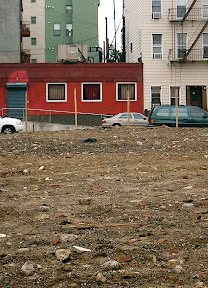
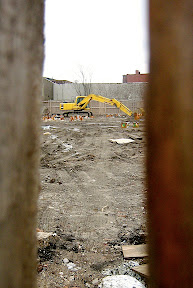
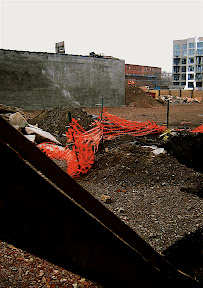
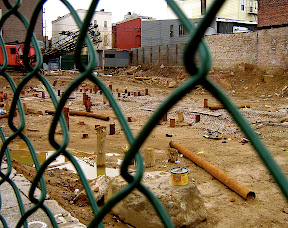
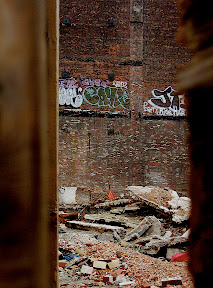
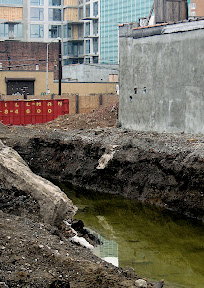
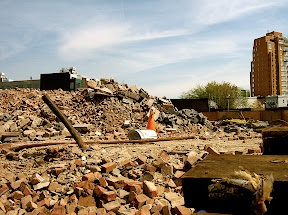
"Whether Armilla is like this because it is unfinished or because it has been demolished, whether the cause is some enchantment or only a whim, I do not know. The fact remains that it has no walls, no ceilings, no floors: it has nothing that makes it seem a city..." Italo Calvino, Invisible Cities





















.jpg)